Mac Literature guides
Close readings of poems and the arguments behind them.
 Literature
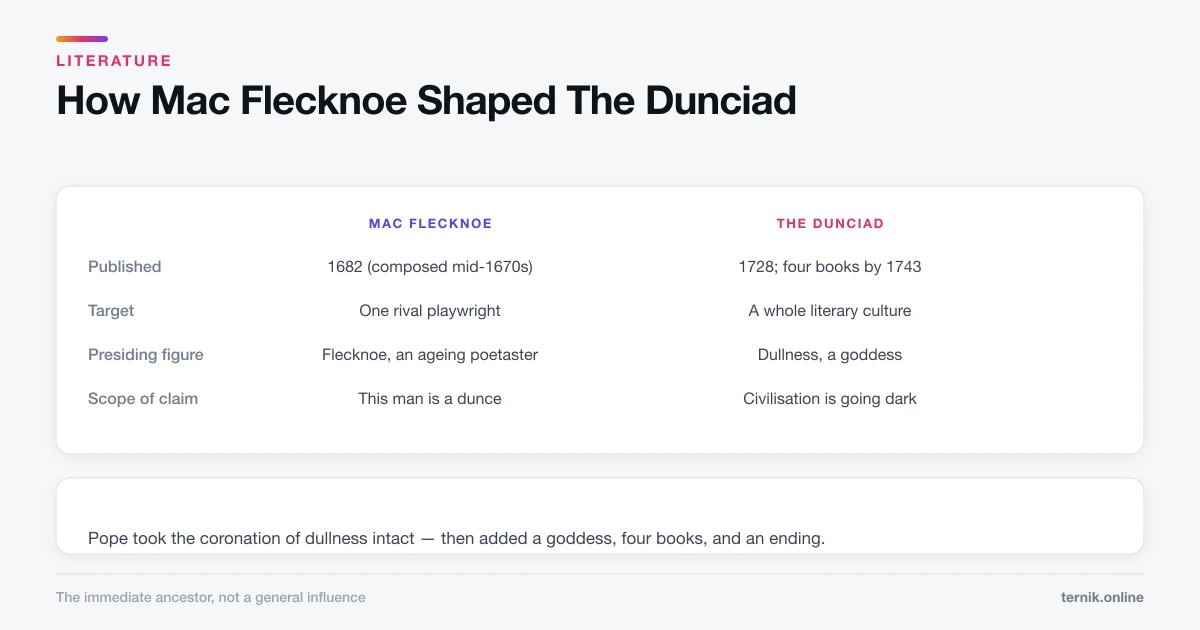
How Mac Flecknoe Shaped The Dunciad
Pope inherited Dryden's mock-heroic method directly, then scaled a personal quarrel into a vision of cultural collapse. Here is what carried over and what changed.
 Literature
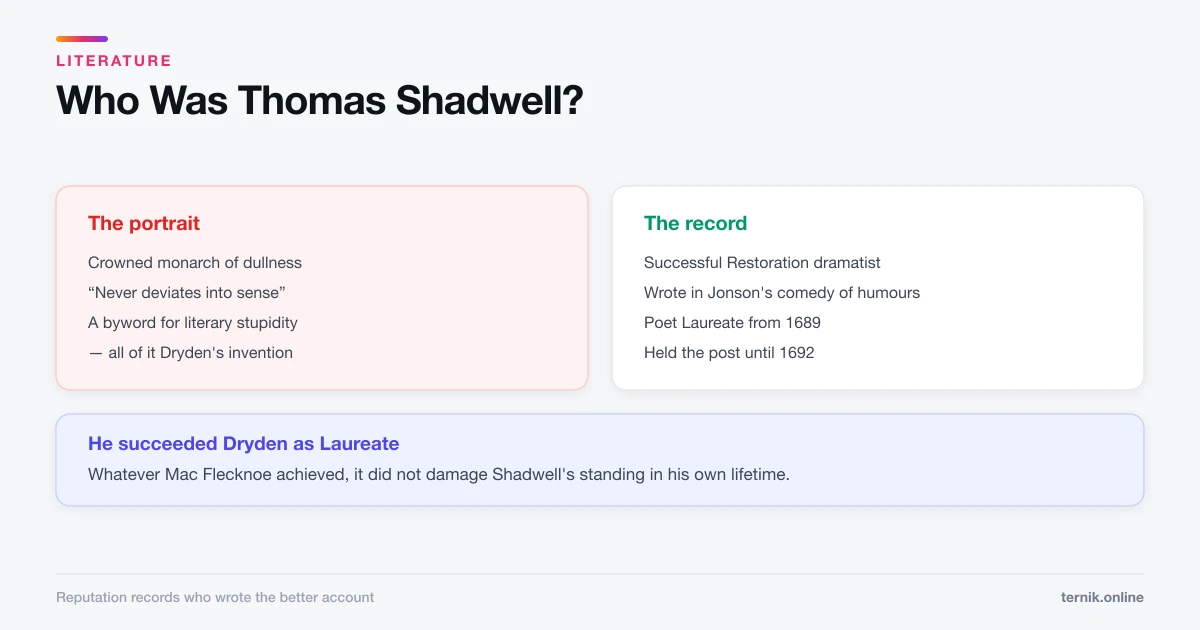
Who Was Thomas Shadwell? The Playwright Dryden Destroyed
Shadwell was a successful Restoration dramatist and Poet Laureate who is remembered almost entirely through the satire written to discredit him.
 Literature
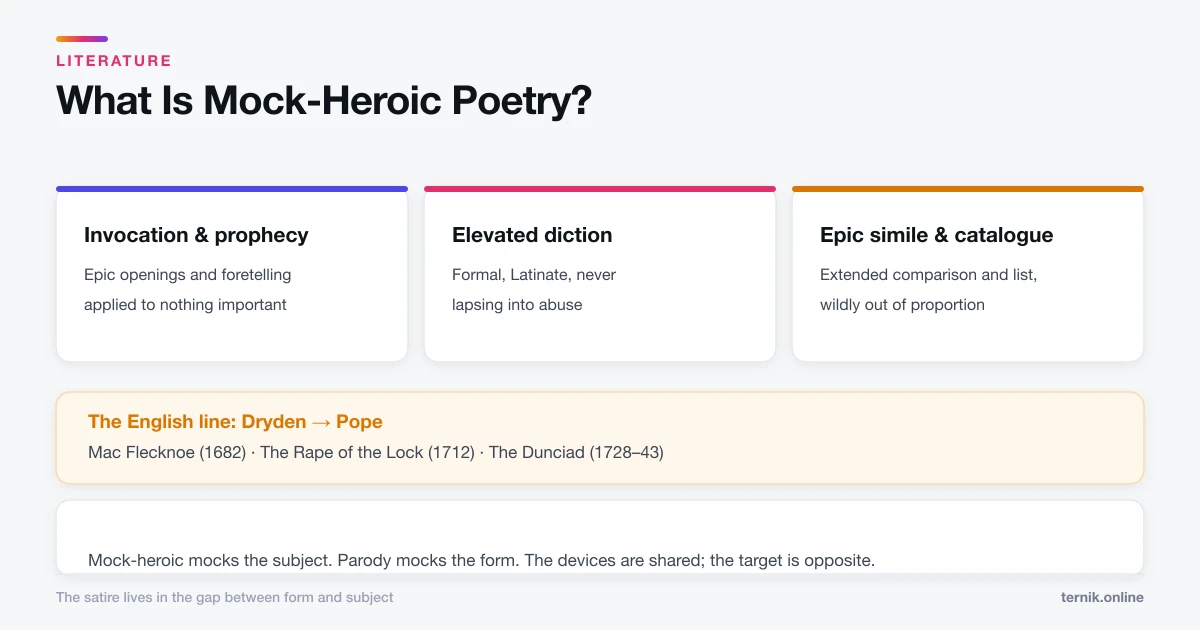
What Is Mock-Heroic Poetry? (With Examples)
Mock-heroic applies the machinery of epic to a trivial subject. The gap between grand form and small matter is the joke — and usually the argument as well.
 Literature
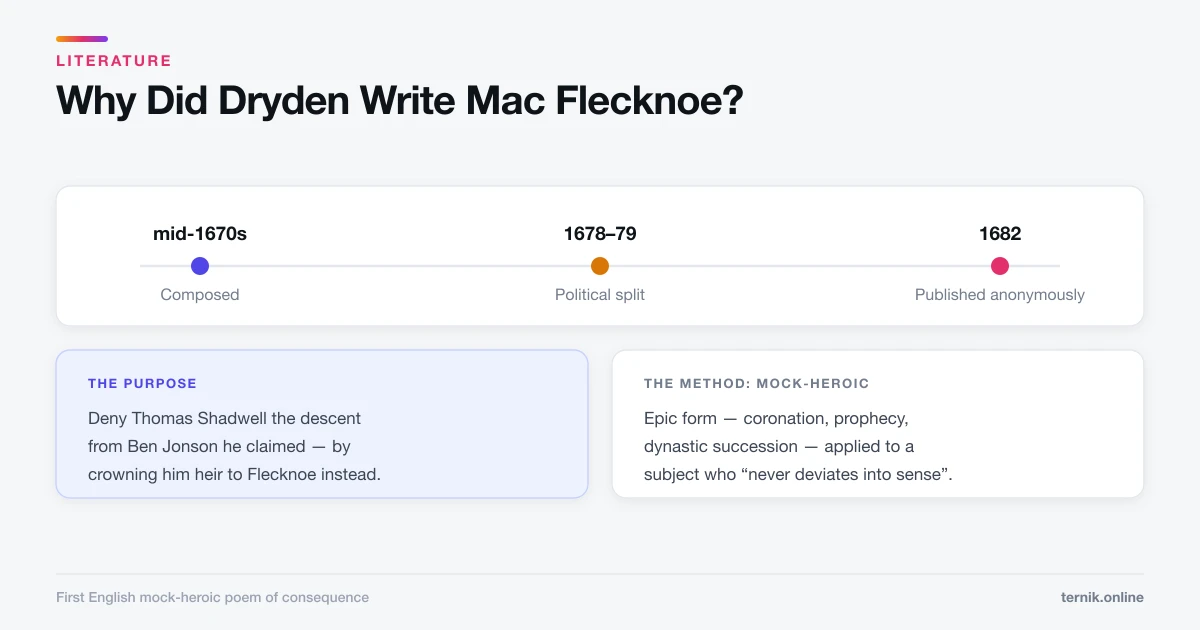
Why Did Dryden Write Mac Flecknoe? Purpose and Context
Dryden wrote Mac Flecknoe to destroy Thomas Shadwell's literary reputation by crowning him king of dullness. The quarrel was about Ben Jonson, politics, and who owned the comic tradition.
About Literature on ternik.online
Literature coverage on this site is narrow by design: individual works, what prompted them, and how they were read at the time. Each piece separates what is documented from what is inferred, because the reception history of a satire is often more contested than the poem itself.
The cluster here centres on one quarrel and its consequences. Why Dryden wrote Mac Flecknoe sets out the purpose behind the poem: not general mockery of bad writing, but a precise attempt to deny one man the literary lineage he had claimed. Thomas Shadwell presented himself as the heir of Ben Jonson; Dryden's answer was to supply an alternative parentage in Richard Flecknoe, a poetaster remembered mainly for paying to have his own unread plays printed. The poem stages a coronation and lets the form pass judgement.
What mock-heroic poetry is explains the technique that makes this work. Mock-heroic applies the full machinery of epic — invocation, prophecy, catalogue, dynastic succession, elevated diction — to a subject that does not deserve it, and the satire lives in the gap between the grandeur of the form and the smallness of the matter. It also distinguishes the mode from parody and burlesque, which are routinely conflated with it and with each other: mock-heroic mocks its subject, parody mocks the form.
Who Thomas Shadwell was is the corrective piece, and the one we think matters most. Shadwell was a commercially successful Restoration dramatist who wrote genuinely in Jonson's comedy-of-humours tradition, and who succeeded Dryden as Poet Laureate in 1689 after the Revolution removed him from the post. He survives in general memory as a byword for literary stupidity because a better poet decided to make him one. Setting the portrait against the record is a useful demonstration that reputation tracks who wrote the most memorable account rather than who had the better case.
How Mac Flecknoe shaped The Dunciad follows the technique forward. Pope inherited Dryden's method essentially intact — the coronation of a dunce, the faithful epic diction, the fabricated succession — then scaled it from a single rival to an entire print culture, adding a presiding goddess of Dullness and an ending in which civilisation goes dark. The expansion has a cost: Mac Flecknoe still works for readers who know nothing of the quarrel behind it, while The Dunciad needs heavy annotation because it names people who mean nothing now.
Read together, these pieces are as much about how literary reputation is made as about the poems. Both Dryden and Pope were writing partisan documents in active disputes, and both won because they wrote better than the people they were arguing with. That is worth carrying into any reading of the results as literary history.
A practical note for students, since that is who usually arrives at these pages. The essay question is normally some form of “what was Dryden's purpose”, and the answerable version is narrower than it first appears: he wanted to deny Shadwell a specific claim to a specific inheritance. Everything else in the poem serves that. If you need the technique named and defined for an exam, start with mock-heroic poetry; if you need the historical context, Shadwell's actual career supplies the dates and the political break that turned a critical disagreement into an attack.