Who Was Thomas Shadwell? The Playwright Dryden Destroyed
Shadwell was a successful Restoration dramatist and Poet Laureate who is remembered almost entirely through the satire written to discredit him.
Short answer
Thomas Shadwell was an English Restoration comic dramatist who modelled his plays on Ben Jonson's comedy of humours. A friend and then rival of John Dryden, he took the Whig side in the crisis of 1678 to 1679 and became the target of Mac Flecknoe. He succeeded Dryden as Poet Laureate in 1689.
Key takeaways
- Shadwell was a successful Restoration comic dramatist, not the dunce of Dryden's portrait.
- He modelled his comedies on Ben Jonson's comedy of humours and defended Jonson publicly.
- He and Dryden were friends before rivals; the break was literary, then political.
- He succeeded Dryden as Poet Laureate in 1689 after the Revolution.
- His reputation today is largely the product of a satire written to destroy it.
Who was Thomas Shadwell?
Thomas Shadwell was an English playwright and poet of the Restoration period, working in London theatre from the late 1660s. He wrote comedies for a commercial audience and was, by the standards that mattered at the time, successful — his plays were performed, printed, and profitable.
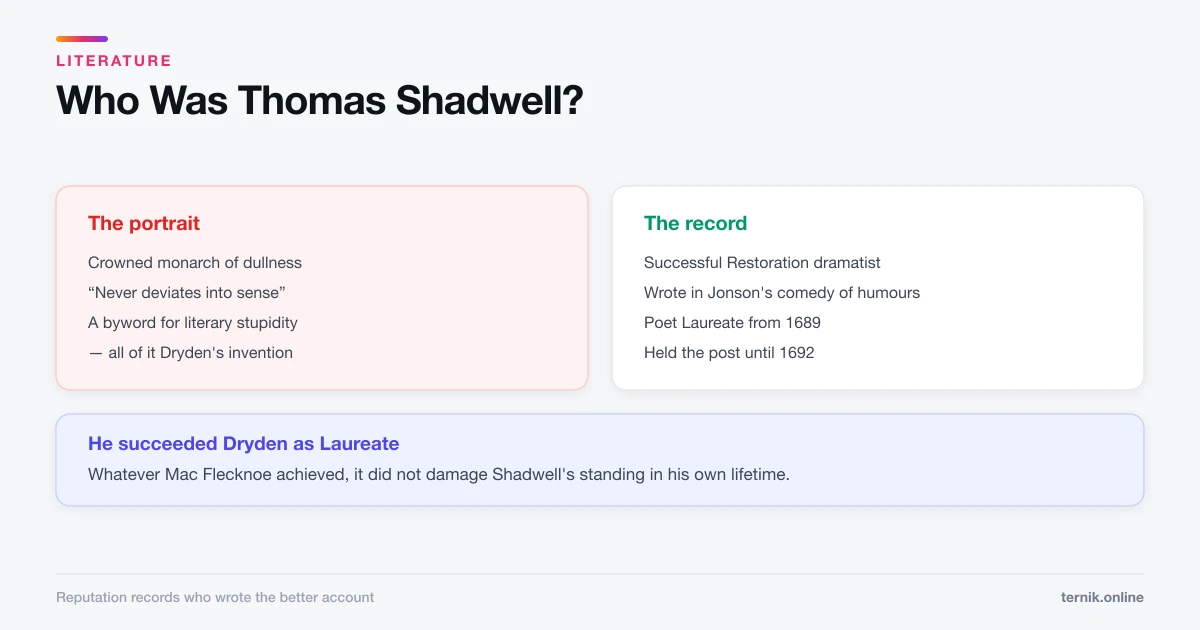
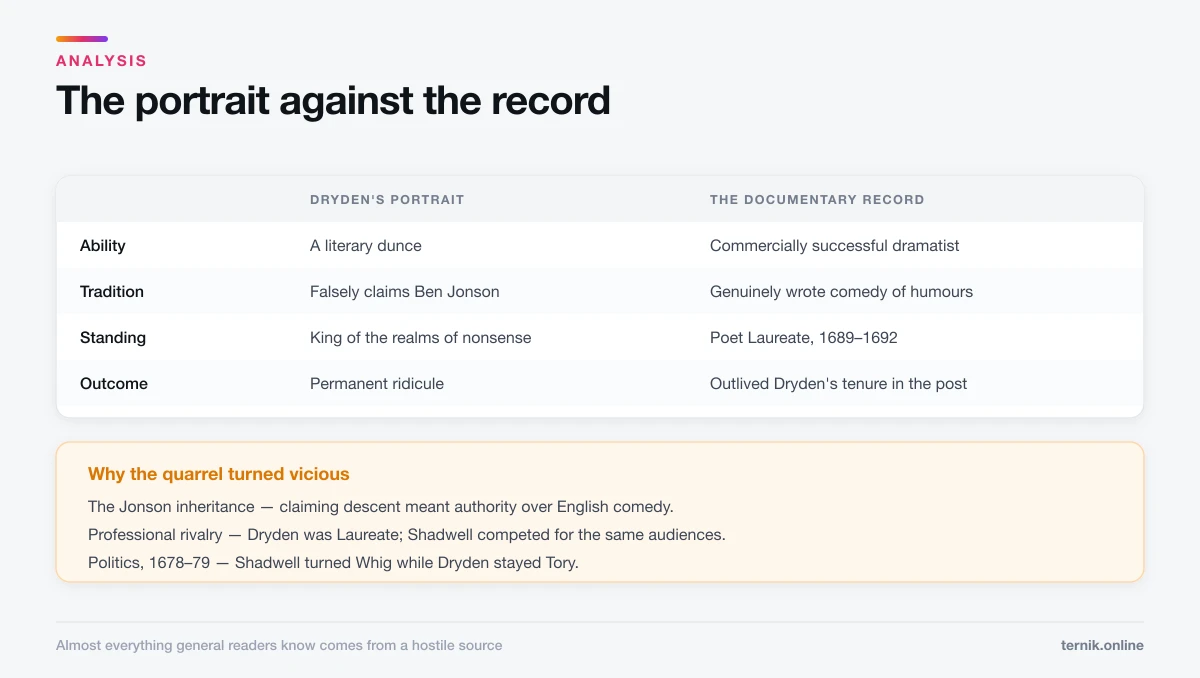
He is now remembered almost entirely as the target of John Dryden's Mac Flecknoe, which crowns him monarch of dullness. That is a striking outcome for a working dramatist who outlived his attacker's tenure as Laureate and took the post himself.
The Jonson question
Shadwell's literary identity rested on Ben Jonson. He wrote in the tradition of the comedy of humours — characters organised around a single dominant trait or obsession — and presented himself as continuing Jonson's project in a theatre he considered had drifted into frivolity.
This was not an eccentric position. Jonson's reputation was high, and claiming his inheritance carried real authority over English comedy.
Dryden disagreed, publicly, in his critical prose. He admired Jonson's judgement but thought his wit overrated, and preferred a comedy of wit and conversation to one of mechanical types. Shadwell defended Jonson; Dryden qualified his praise again. Each thought the other had misread the tradition.
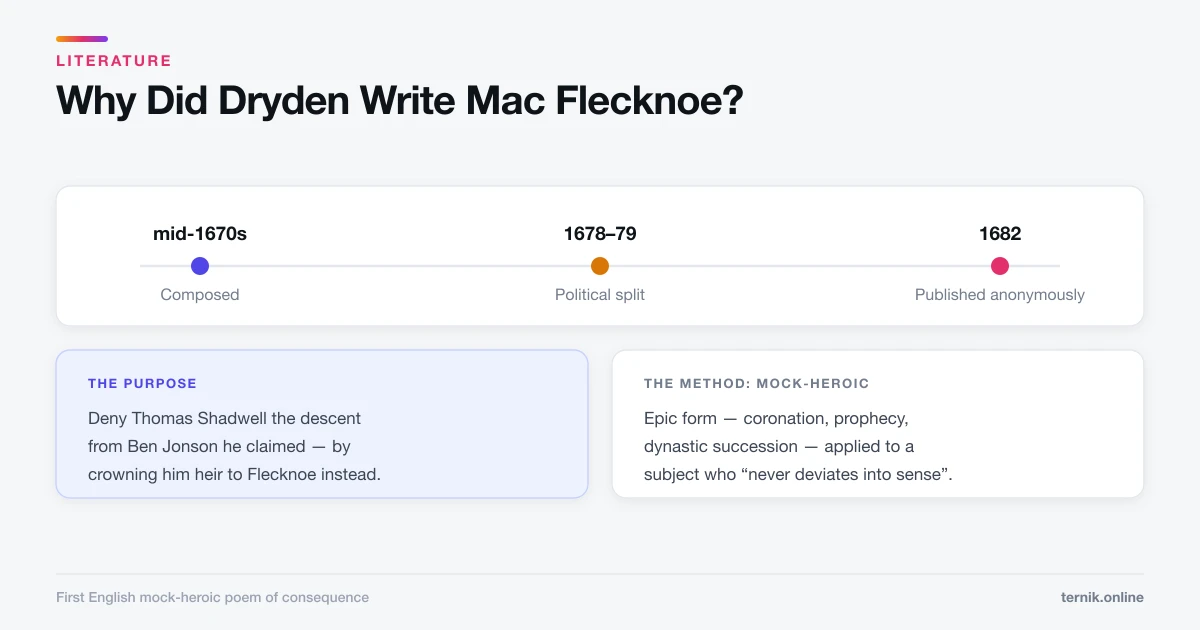
That argument — genuinely about aesthetics — is the seed of the satire. The full account is in why Dryden wrote Mac Flecknoe.
From friends to enemies
The two men were on good terms before the quarrel hardened, which is what gives the eventual attack its edge. Three things pushed them apart:
- The critical disagreement over Jonson, conducted in prefaces and prologues.
- Professional competition for the same audiences and theatrical commissions.
- Politics. During the crisis of 1678–79, Shadwell took the Whig side while Dryden remained a Tory. In that climate literary disputes acquired factional weight and satire became an ordinary instrument of public argument.
Laureate after Dryden
The ending is the part most summaries omit. After the Revolution of 1688 deposed James II, Dryden — a Catholic convert and Tory — lost the laureateship. Shadwell was appointed in his place in 1689.
So the man Dryden had crowned king of nonsense went on to hold the office Dryden had held, by the same authority. Whatever the poem achieved, it did not damage Shadwell's standing in his own lifetime.
He held the post until his death in 1692.
What the satire did to his reputation
This is the genuinely interesting question, and it is a case study in how literary reputation actually works.
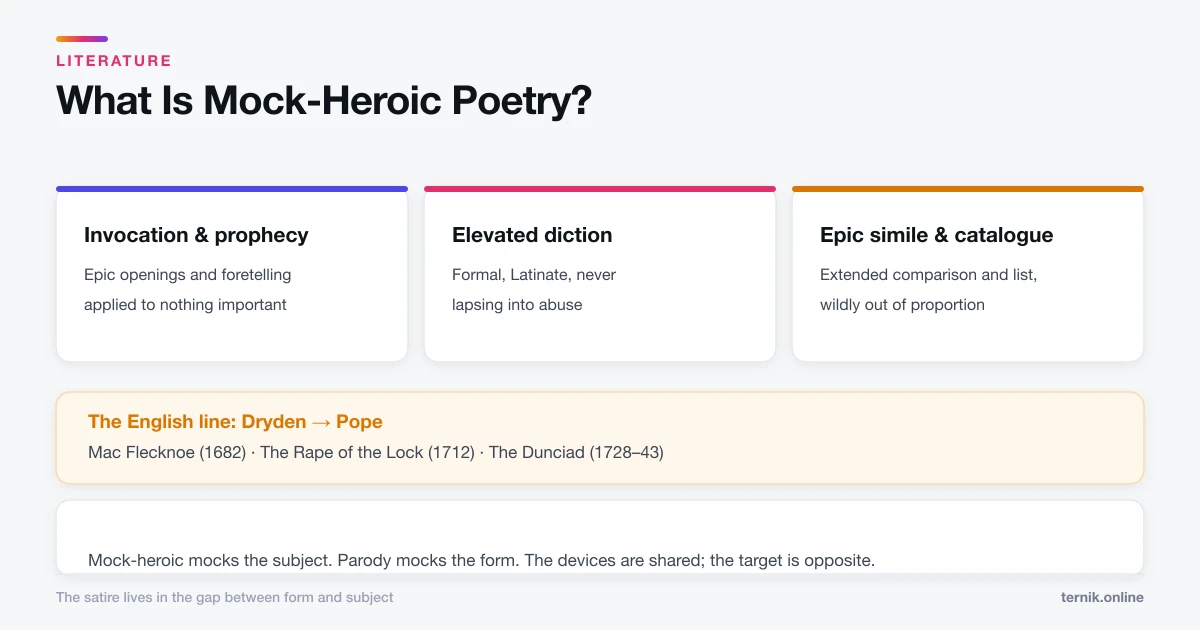
Mac Flecknoe does not argue that Shadwell's plays are bad. It makes no case about his dramaturgy at all. It stages a coronation and lets the mock-heroic form pass judgement — a technique explained in what is mock-heroic poetry.
The consequences were long-run rather than immediate:
- In his lifetime: minimal. He kept working and became Laureate.
- In the eighteenth century: Pope reinforced the portrait, and the anthologies followed.
- Since: he survives as a name attached to Dryden's poem rather than to his own plays.
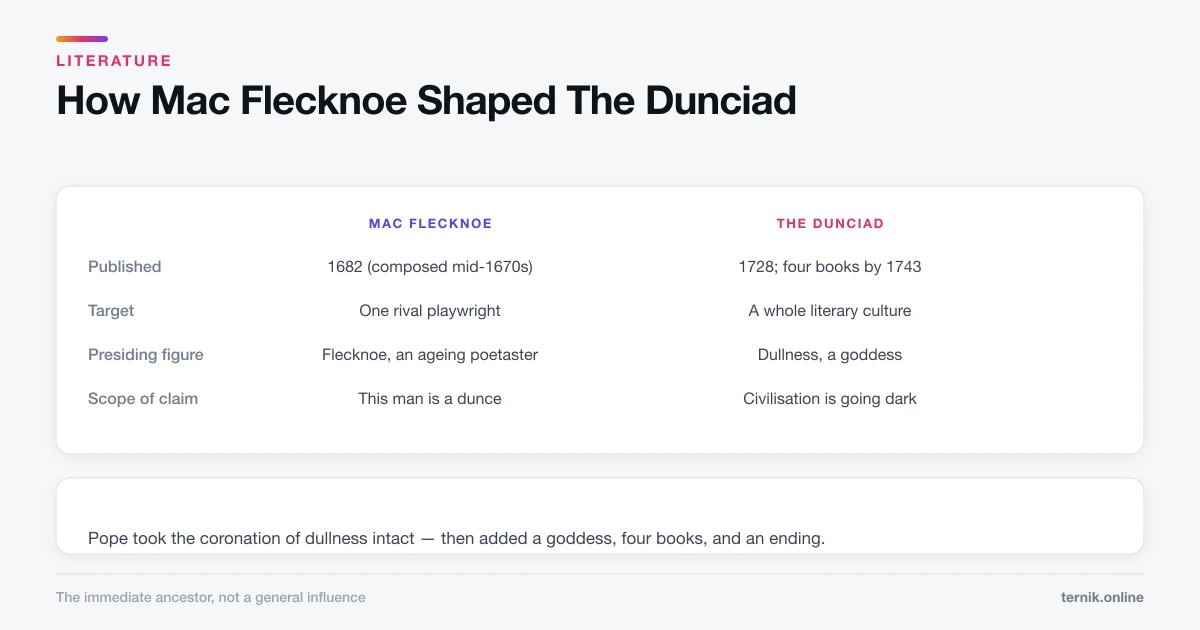
The lesson is uncomfortable. Reputation is not a record of merit but of who wrote the most memorable account — and Dryden was the better poet by a wide margin. Pope's expansion of the same technique in The Dunciad did the same thing to a much larger cast, as traced in how Mac Flecknoe shaped The Dunciad.
Reading Shadwell now
Two cautions are worth carrying.
Separate the evidence from the portrait. Almost everything the general reader knows about Shadwell comes from a hostile source. That does not make Dryden's judgement worthless — he was an acute critic — but it is testimony from a partisan in an active quarrel, not a neutral assessment.
Do not overcorrect either. Rehabilitating Shadwell as a neglected genius overstates the case in the opposite direction. He was a capable professional dramatist working in a mode Dryden disliked. That is a duller conclusion than either the satire or its rebuttal, and it is closer to what the record supports.
Frequently asked questions
An English Restoration comic dramatist who wrote in Ben Jonson's comedy-of-humours tradition, and who succeeded John Dryden as Poet Laureate in 1689.
Sources
Keep reading
More guides to grow your account.