What Is Mock-Heroic Poetry? (With Examples)
Mock-heroic applies the machinery of epic to a trivial subject. The gap between grand form and small matter is the joke — and usually the argument as well.
Short answer
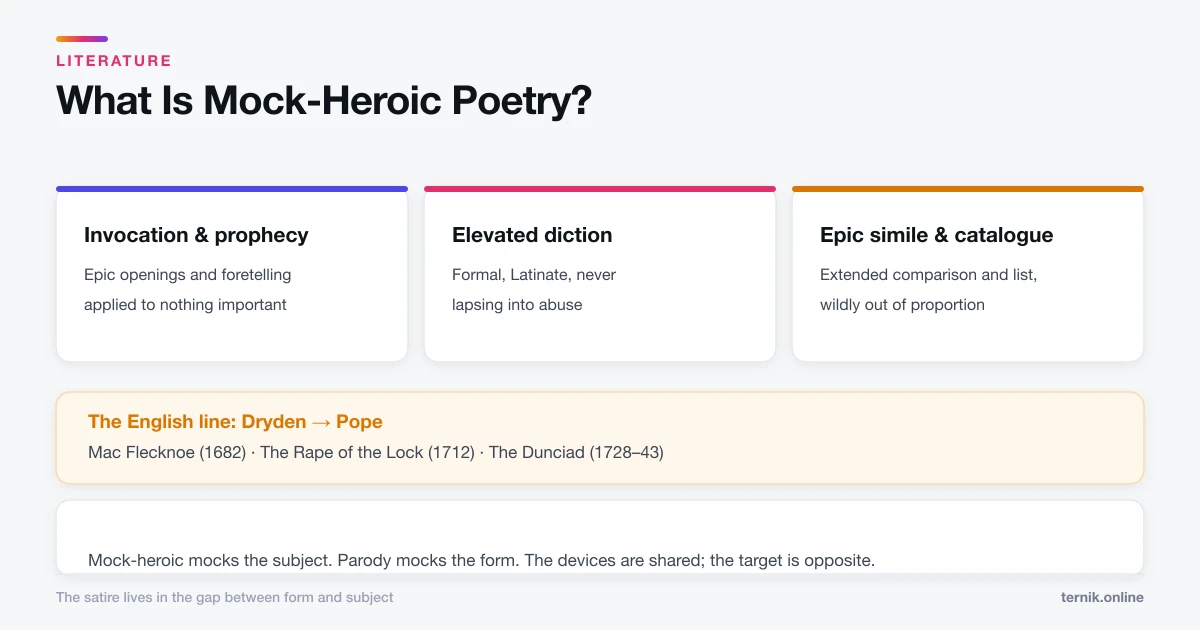
Mock-heroic poetry treats a trivial subject with the conventions of epic — invocations, prophecy, catalogues, and elevated diction. The mismatch between the grandeur of the form and the smallness of the subject produces the satire. The major English examples are Dryden's Mac Flecknoe, Pope's The Rape of the Lock, and Pope's The Dunciad.
Key takeaways
- Mock-heroic applies epic conventions to a subject that does not deserve them.
- The satire lives in the gap between form and subject, not in insults.
- Standard devices: invocation, prophecy, catalogue, epic simile, elevated diction.
- The English line runs Dryden → Pope: Mac Flecknoe, The Rape of the Lock, The Dunciad.
- It differs from parody: mock-heroic mocks the subject, parody mocks the form.
What is mock-heroic poetry?
Mock-heroic — also called mock-epic — is a satirical mode that describes a trivial subject in the language and structure of epic. The poet keeps the full apparatus of heroic verse and points it at something unworthy: a quarrel over a lock of hair, a bad playwright, a card game.
The reader is expected to know the conventions being borrowed. Recognising that a scene is staged like a coronation, or that a speech is built like an epic prophecy, is what makes the mismatch funny. Without that recognition the poem reads as merely pompous.
Crucially, the form is not being ridiculed. Dryden and Pope both revered epic; Pope translated Homer. They deploy its dignity deliberately, because dignity applied to something small is more devastating than abuse.
The standard devices
Mock-heroic poems reuse a recognisable toolkit:
- Invocation of the muse — a grand opening appeal, for a subject that needs no divine help.
- Elevated diction — Latinate vocabulary and formal syntax throughout, never lapsing into slang.
- Epic simile — an extended comparison, usually wildly out of proportion.
- Catalogue — the epic list of ships or warriors, repurposed for something trivial.
- Prophecy and succession — a figure foretells a dynasty, converting a moment into a permanent condition.
- Supernatural machinery — gods and spirits intervening in domestic events.
Mock-heroic, parody, and burlesque
These three get conflated constantly, and the distinction is worth holding onto.
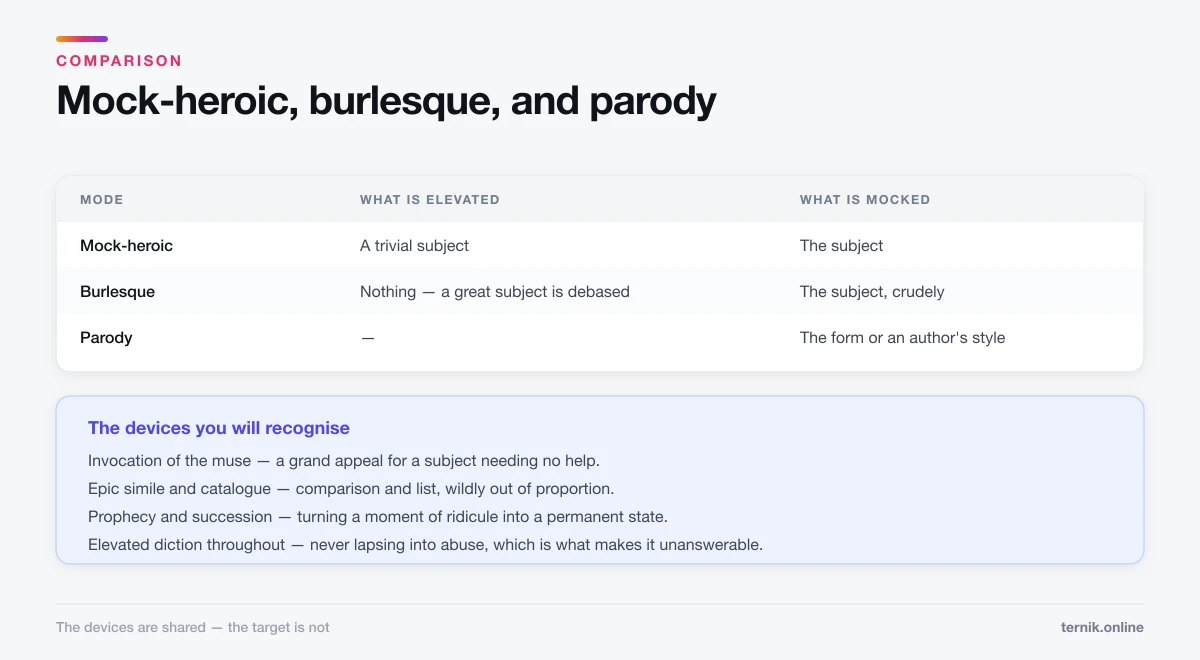
| Mode | What is elevated | What is mocked |
|---|---|---|
| Mock-heroic | A trivial subject | The subject |
| Burlesque (low) | Nothing — a great subject is debased | The subject, crudely |
| Parody | — | The form or a specific author's style |
A parody of Homer imitates Homer's manner to make Homer look absurd. A mock-heroic poem uses Homer's manner faithfully to make its own subject look absurd. The technique is similar; the target is opposite.
The English examples
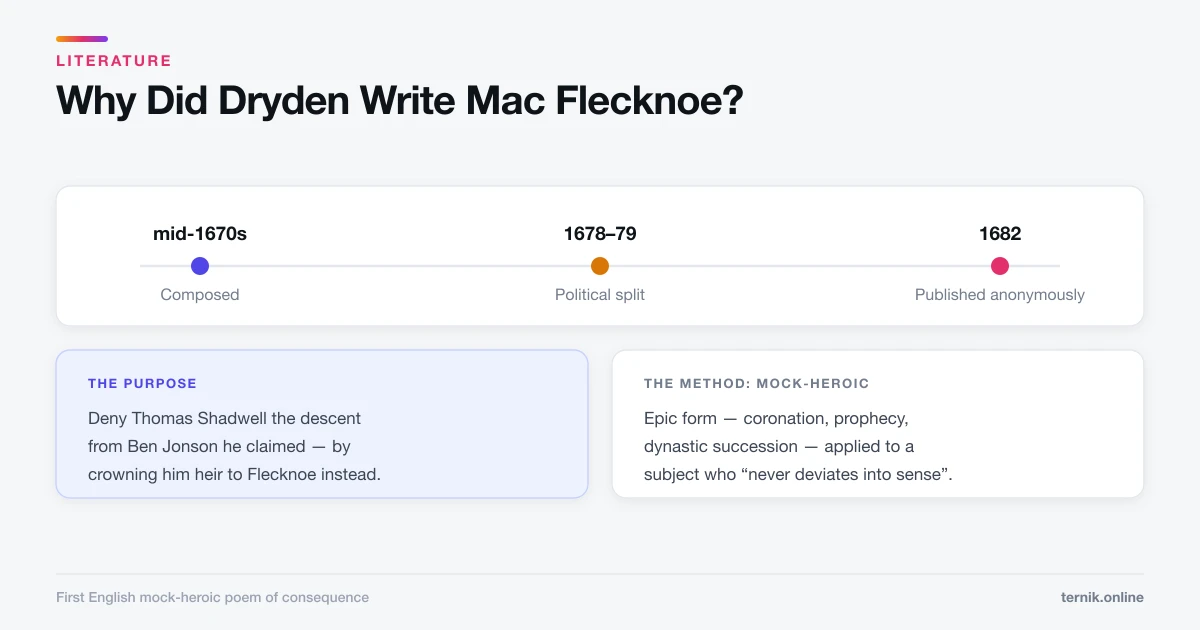
Dryden, Mac Flecknoe (composed mid-1670s, published 1682). Generally treated as the first consequential English mock-heroic poem. A coronation scene enthrones the playwright Thomas Shadwell as monarch of dullness. Why Dryden wrote it — and what he was actually arguing about — is covered in why Dryden wrote Mac Flecknoe.
Pope, The Rape of the Lock (1712, expanded 1714). A real quarrel between two families over a lock of hair cut without permission, told with sylphs, an epic card game, and a battle. It is the most affectionate of the three — Pope is teasing his subjects, not destroying them.
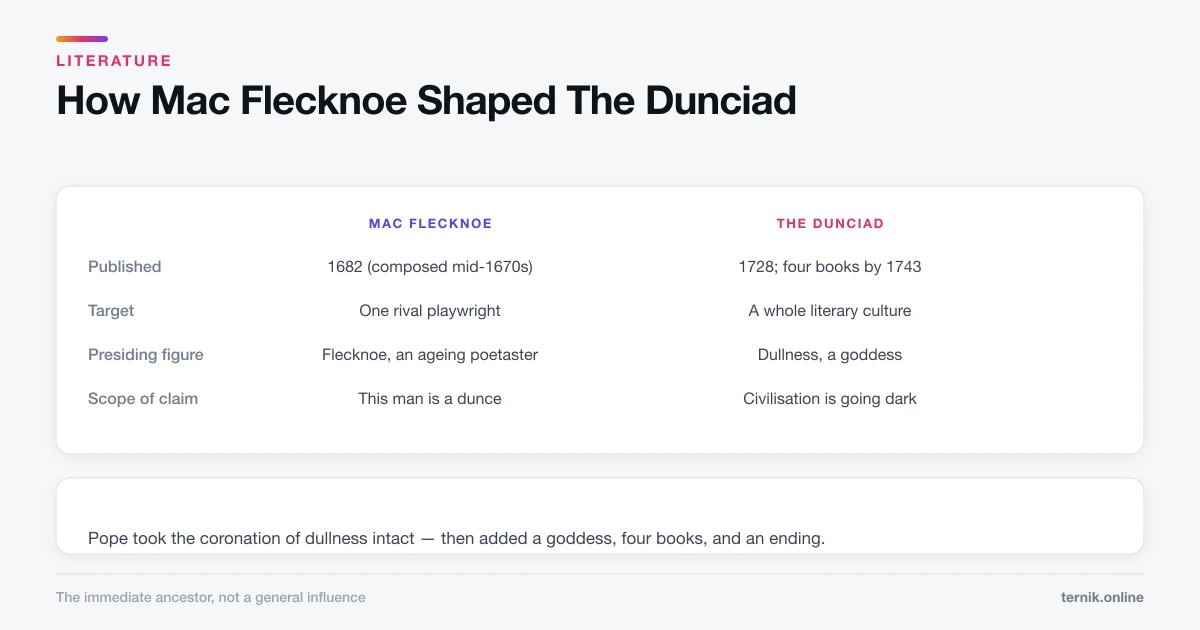
Pope, The Dunciad (1728, final four-book form 1743). The mode turned back into a weapon and expanded enormously: a mock-epic of cultural collapse, with a goddess of Dullness extinguishing civilisation. Its debt to Dryden is direct, as traced in how Mac Flecknoe shaped The Dunciad.
Why poets chose this mode
Three reasons, all practical.
It is unanswerable. Direct insult invites a reply in kind. Sustained mock-epic offers the target no dignified response — protesting merely confirms the portrait.
It flatters the reader. Recognising the borrowed conventions makes the audience a participant. That shared recognition builds consensus against the target, which is exactly the point of literary satire.
It permits scale. Because epic addresses the fate of nations, mock-epic can inflate a private quarrel into a claim about the culture. Pope uses this to argue that bad writing is a civilisational problem rather than a personal failing.
Reading a mock-heroic poem
Four things help.
Read it aloud. The comedy is largely tonal, and the deadpan formality of heroic couplets carries much of it. On the page it can read as merely stately.
Notice the machinery. Each time an epic convention appears, ask what it is being applied to. That gap is the joke.
Do not expect argument. Mock-heroic rarely makes a case against its target. It stages a scene and lets the form pass judgement — which is why the mode is so effective and so unfair.
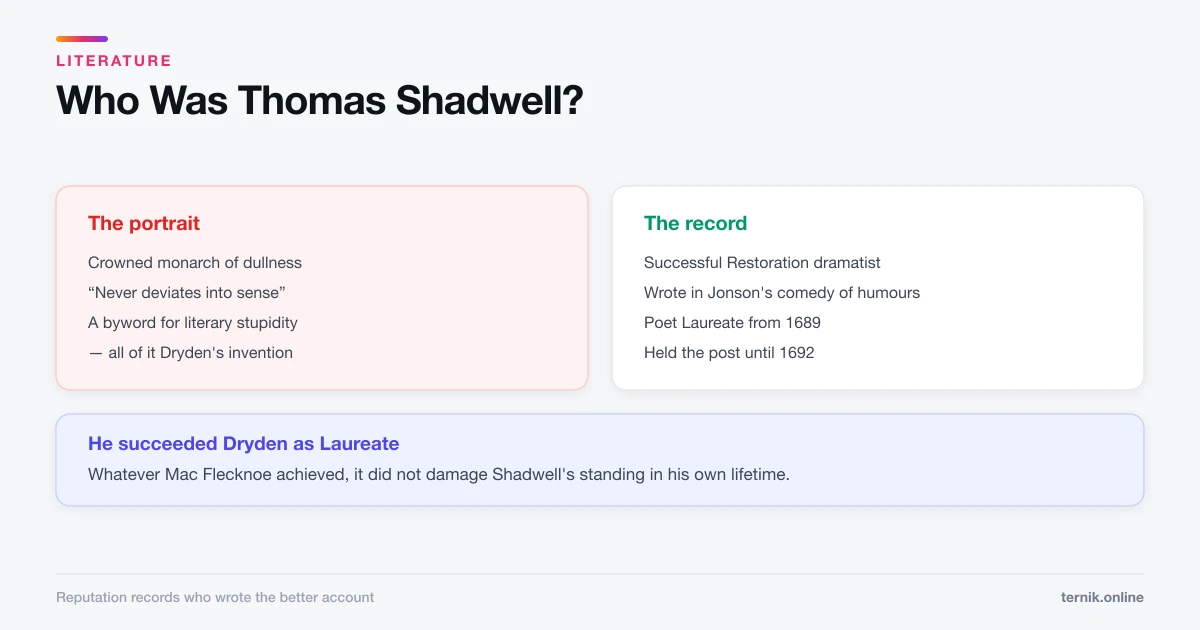
Remember it is partisan. These poems are written by hostile witnesses who were also the better writers. Mac Flecknoe is the clearest case: Shadwell was a competent, popular dramatist who has come down to us as a byword for stupidity because Dryden decided it. For what is actually known about him, see who was Thomas Shadwell.
After Pope
The mode did not survive intact. The Romantics valued sincerity over ironic distance, and mock-heroic depends on a stable, shared sense of literary hierarchy — a consensus about what counts as elevated. Once that consensus fractured, the technique lost its footing.
Its descendants are everywhere, though: any comic writing that applies solemn treatment to a petty subject is working the same seam.
Frequently asked questions
A satirical mode that treats a trivial subject using the conventions of epic — invocation, prophecy, elevated diction. The mismatch between grand form and small subject creates the satire.
Sources
Keep reading
More guides to grow your account.