Why Did Dryden Write Mac Flecknoe? Purpose and Context
Dryden wrote Mac Flecknoe to destroy Thomas Shadwell's literary reputation by crowning him king of dullness. The quarrel was about Ben Jonson, politics, and who owned the comic tradition.
Short answer
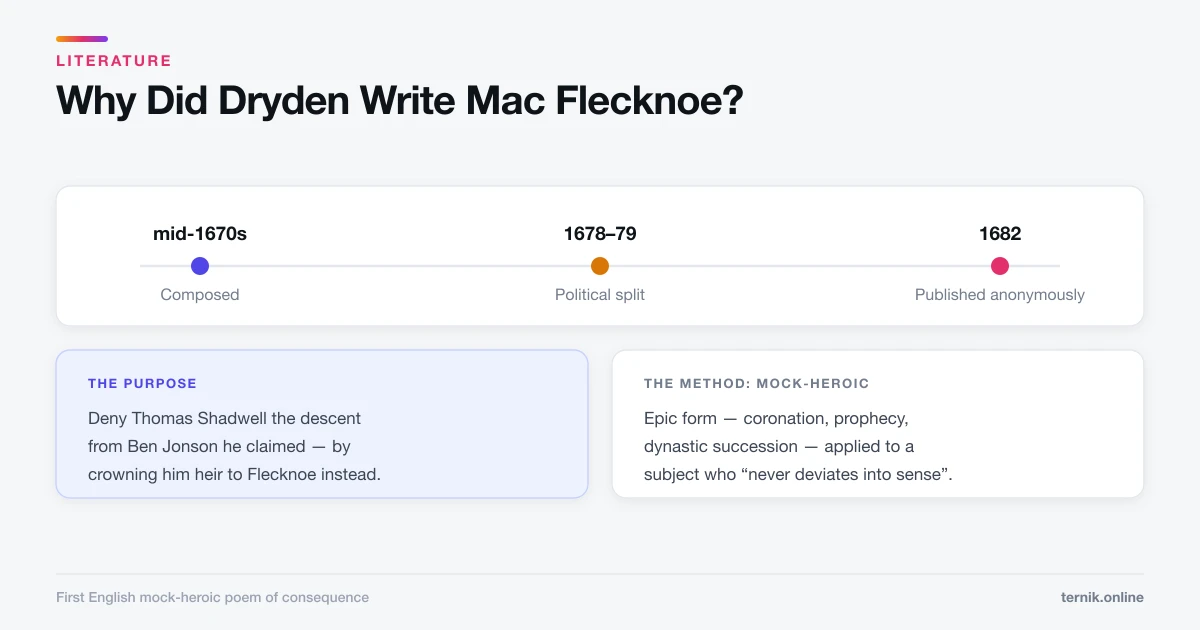
Dryden composed Mac Flecknoe to demolish the reputation of the playwright Thomas Shadwell, who had claimed to be the true heir of Ben Jonson. Using mock-heroic form, Dryden crowns Shadwell as successor to the notoriously bad poet Richard Flecknoe and ruler of the realms of nonsense. The quarrel combined a literary disagreement about Jonson's wit with the Whig and Tory politics of 1678 to 1679.
Key takeaways
- Dryden's purpose was to destroy Thomas Shadwell's literary standing, not merely to mock him.
- The satire works by mock-heroic inversion — epic grandeur applied to a coronation of dullness.
- The literary quarrel was over Ben Jonson's wit and who could claim his inheritance.
- The political rupture of 1678–79 turned a critical disagreement into an attack.
- It was written in the mid-1670s but published anonymously in 1682, apparently without Dryden's authority.
What was Dryden's purpose in composing Mac Flecknoe?
Dryden wrote Mac Flecknoe to annihilate the reputation of a rival playwright by making him permanently ridiculous. The poem's method is a coronation: the aged monarch of dullness, Richard Flecknoe, surveys his realm and chooses Thomas Shadwell as his successor, the son who "never deviates into sense."
The purpose is precise rather than general. Dryden is not writing against bad poetry in the abstract — he is denying one specific man the literary lineage that man had claimed for himself. Shadwell presented himself as the true heir of Ben Jonson. Dryden's answer was to supply an alternative parentage: not Jonson, but Flecknoe, a poetaster remembered chiefly for paying to have his own unread plays printed.
That is what makes the satire lethal. It does not argue that Shadwell is a poor writer. It stages his enthronement as the greatest of all poor writers, with full epic ceremony, and lets the form do the damage.
Who was Thomas Shadwell?
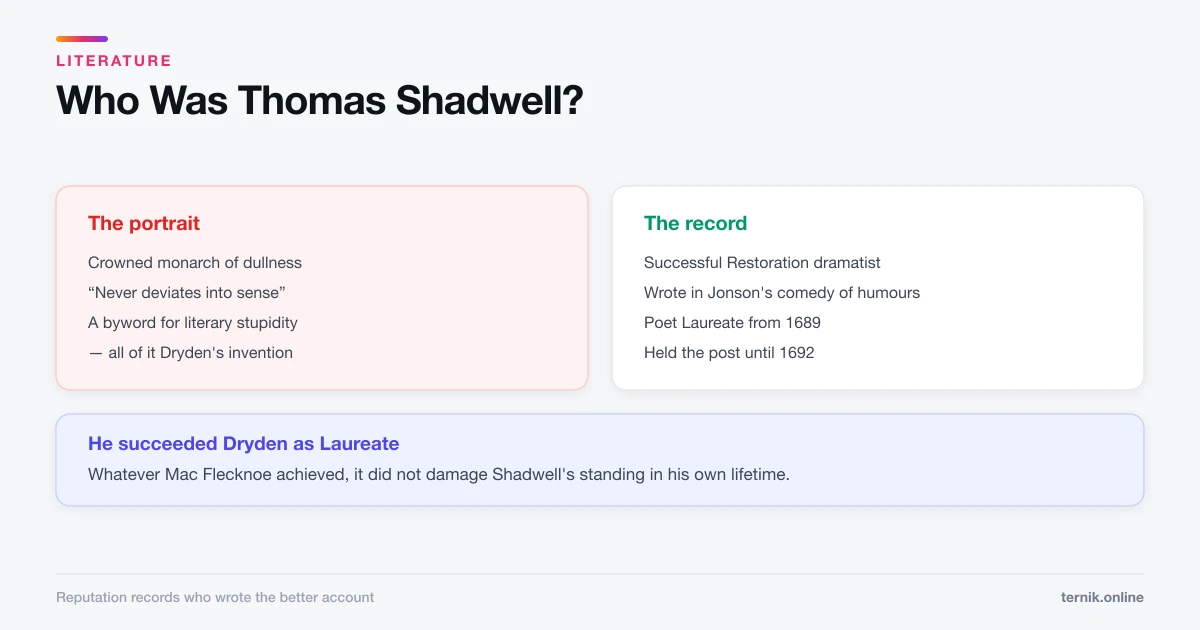
Shadwell was a successful Restoration comic dramatist and a friend of Dryden's before the quarrel hardened — the fuller record of his career is considerably less damning than the poem. He is remembered now almost entirely through Dryden's portrait of him, which is itself part of the poem's achievement and a reason to be careful: our sense of Shadwell as a dunce is substantially Dryden's invention.
The disagreement between them was genuine and literary before it became personal. Shadwell revered Ben Jonson and modelled his comedies on Jonsonian "humours" — characters organised around a single dominant trait. Dryden thought Jonson's wit overrated and said so in his critical prose. Shadwell defended Jonson; Dryden qualified his praise. Each accused the other of misunderstanding the tradition.
Why the quarrel turned vicious
A difference of critical opinion does not usually produce a poem like this. Three pressures converged.
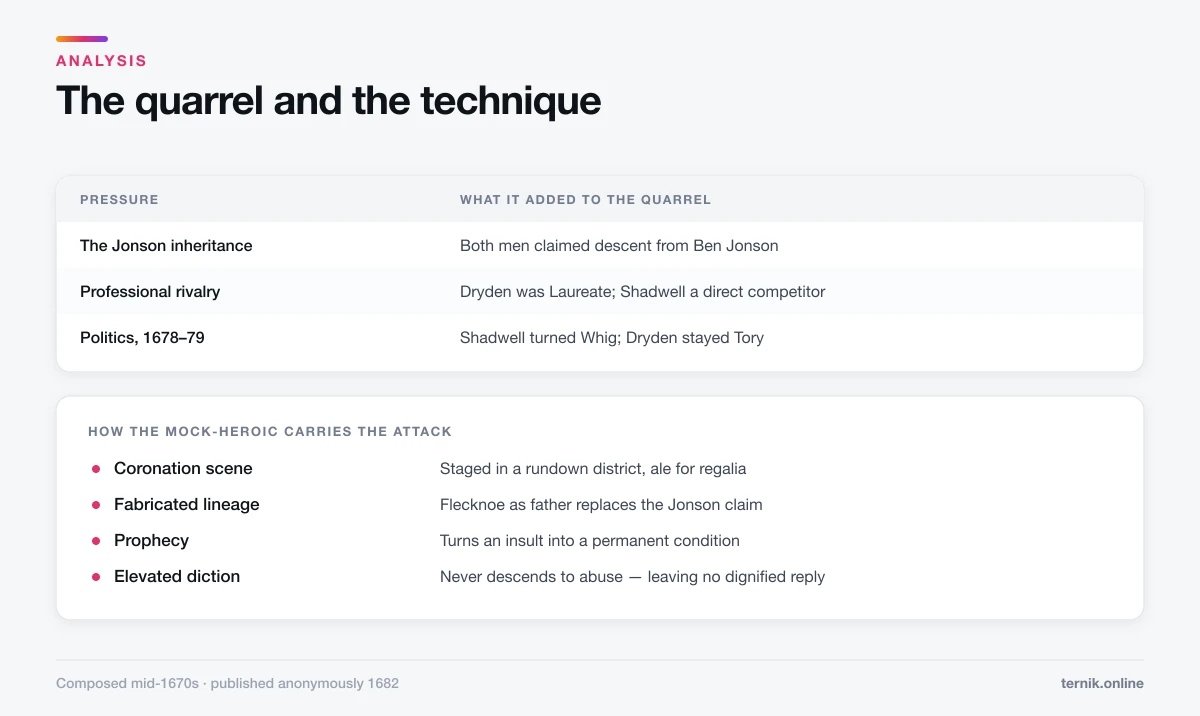
The Jonson inheritance. To claim descent from Jonson in the 1670s was to claim authority over English comedy. Both men wanted it. Only one could plausibly hold it.
Professional rivalry. Dryden was Poet Laureate. Shadwell was a working competitor for the same audiences and the same theatrical commissions, and would in fact succeed Dryden as Laureate after the Revolution of 1688 — an outcome the poem could not have anticipated but which sharpens its irony in retrospect.
Politics. The friendship broke down during the crisis of 1678–79, when Shadwell took the Whig side and Dryden remained a Tory. In that climate a literary disagreement acquired factional weight, and satire became a normal instrument of public argument.
How the mock-heroic form carries the attack
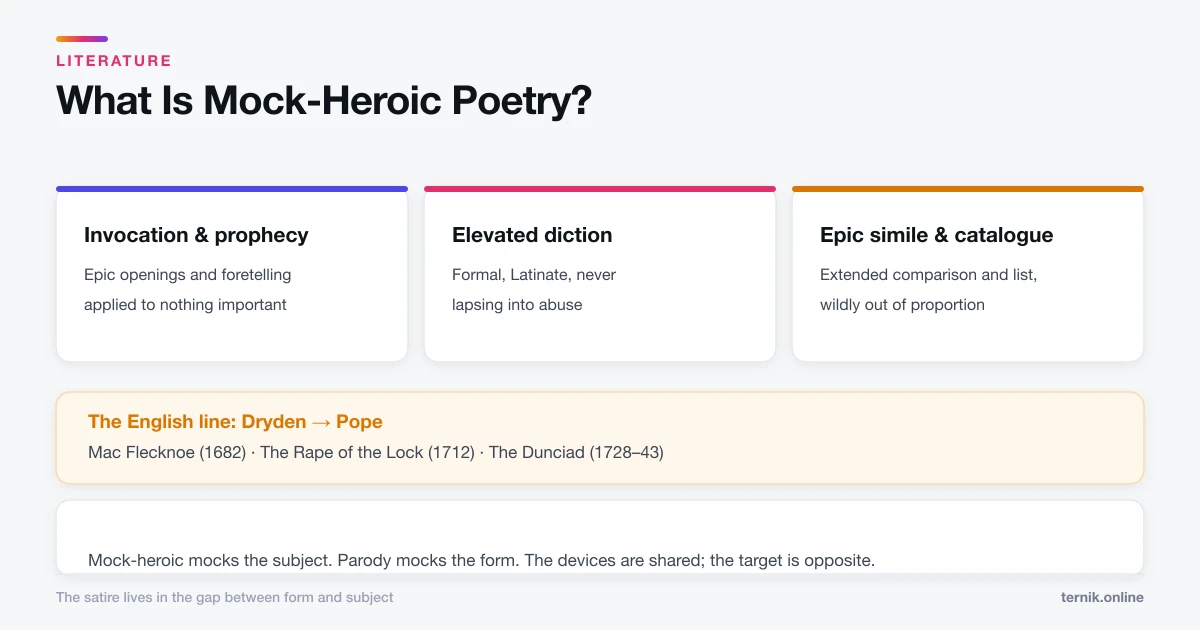
Mock-heroic applies the machinery of epic — invocations, prophecy, coronation, dynastic succession — to a subject unworthy of it. The gap between the grandeur of the form and the smallness of the subject is the joke, and it is also the argument.
Several devices do the work:
- The coronation scene. Shadwell is crowned in a rundown district of London rather than a palace, with mugs of ale in place of regalia.
- Fabricated lineage. By making Flecknoe the father, Dryden replaces the parentage Shadwell wanted with one that condemns him.
- Physical caricature. Shadwell's bulk becomes a figure for mental heaviness.
- Prophecy. Flecknoe foresees a reign of unbroken dullness, converting an insult into a permanent condition.
- Elevated diction throughout. Dryden never drops into abuse; the poem stays dignified while its subject does not.
This last point is what separates Mac Flecknoe from ordinary lampoon. Straightforward insult invites a reply in kind. Sustained mock-epic leaves the target no dignified way to respond at all.
The publication problem
The poem was composed in the mid-1670s but appeared in print in 1682, published anonymously and, by most accounts, without Dryden's authorisation. It had circulated in manuscript for years beforehand, which was ordinary practice for satire that named living people.
Two things follow, and both are worth stating plainly rather than smoothing over. The gap between composition and publication means the poem entered public view in a political moment sharper than the one that produced it. And because the printing was unauthorised, the text's early history is less settled than a modern anthology heading implies — attribution and dating here rest on inference as much as on record.
Why it still matters
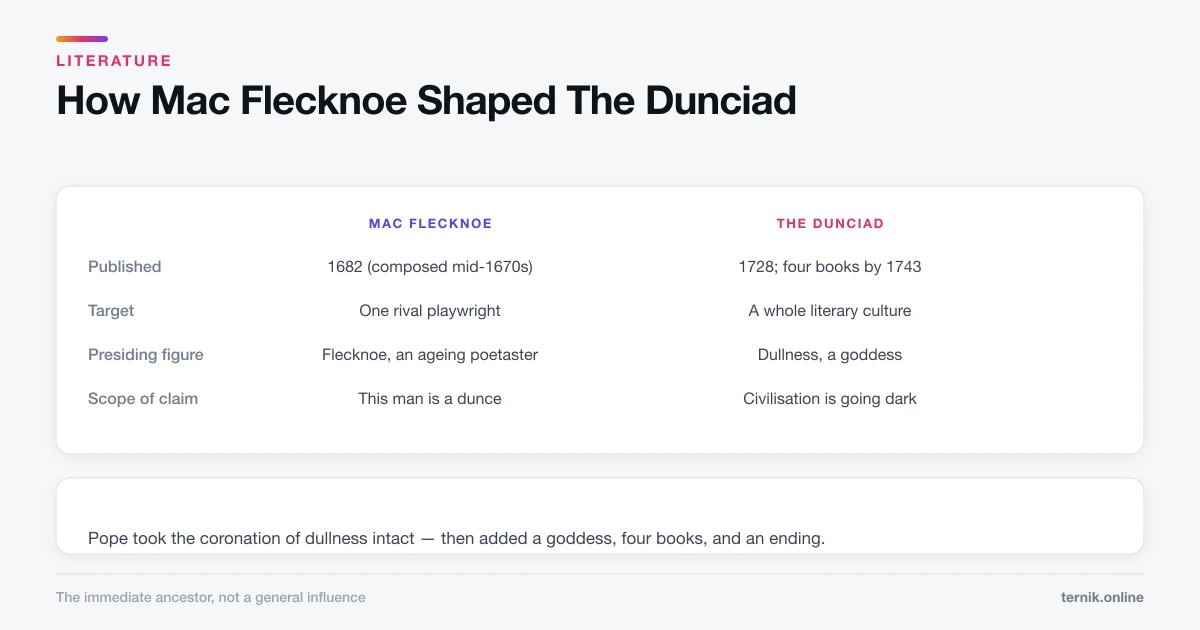
Mac Flecknoe is generally described as the first English mock-heroic poem of consequence, and it established the model that Alexander Pope inherited directly in The Dunciad. Pope's expansion of a personal quarrel into a vision of cultural collapse begins here — what carried over and what changed is worth tracing in detail.
Its more uncomfortable legacy is the one already noted: it worked. Shadwell was a competent and popular dramatist who became, and remains, a byword for literary stupidity because a better poet decided to make him one. The poem is a demonstration that reputation is not a record of merit but of who wrote the most memorable account.
Reading it now
Three things help on a first pass. Read it aloud — the heroic couplets carry a deadpan formality that carries much of the comedy. Do not look for arguments about Shadwell's actual plays, because the poem makes none; its case is entirely tonal. And keep in mind that you are reading a partisan document by a hostile witness who was also the better writer, which is exactly why his version won.
Frequently asked questions
To destroy Thomas Shadwell's literary reputation by crowning him heir to the notoriously bad poet Richard Flecknoe, denying Shadwell the descent from Ben Jonson he had claimed.
Sources
Keep reading
More guides to grow your account.