How Mac Flecknoe Shaped The Dunciad
Pope inherited Dryden's mock-heroic method directly, then scaled a personal quarrel into a vision of cultural collapse. Here is what carried over and what changed.

Short answer
Mac Flecknoe is the immediate ancestor of The Dunciad. Pope took Dryden's method — a coronation of dullness told in faithful epic form — and expanded it from a single rival to an entire literary culture, adding a presiding goddess and a prophecy of civilisational darkness.
Key takeaways
- Mac Flecknoe is the immediate ancestor of The Dunciad; the debt is direct, not general.
- Both stage a coronation of dullness in faithful epic form.
- Pope scaled the target from one rival to a whole literary culture.
- The Dunciad appeared in 1728 and reached its four-book form in 1743.
- Pope added a presiding goddess and an ending that Dryden's poem does not attempt.
What Pope took from Dryden
The inheritance is specific. Dryden had shown that you could destroy a literary reputation by treating it with complete formal seriousness, and Pope adopted the machinery essentially intact:
- The coronation of a dunce as the organising scene.
- Faithful epic diction maintained throughout, never dropping into abuse.
- Fabricated succession — a line of dullness with its own dynastic logic.
- Prophecy, which turns a moment of ridicule into a permanent settled state.
- Named living targets, with the attendant risk that involved.
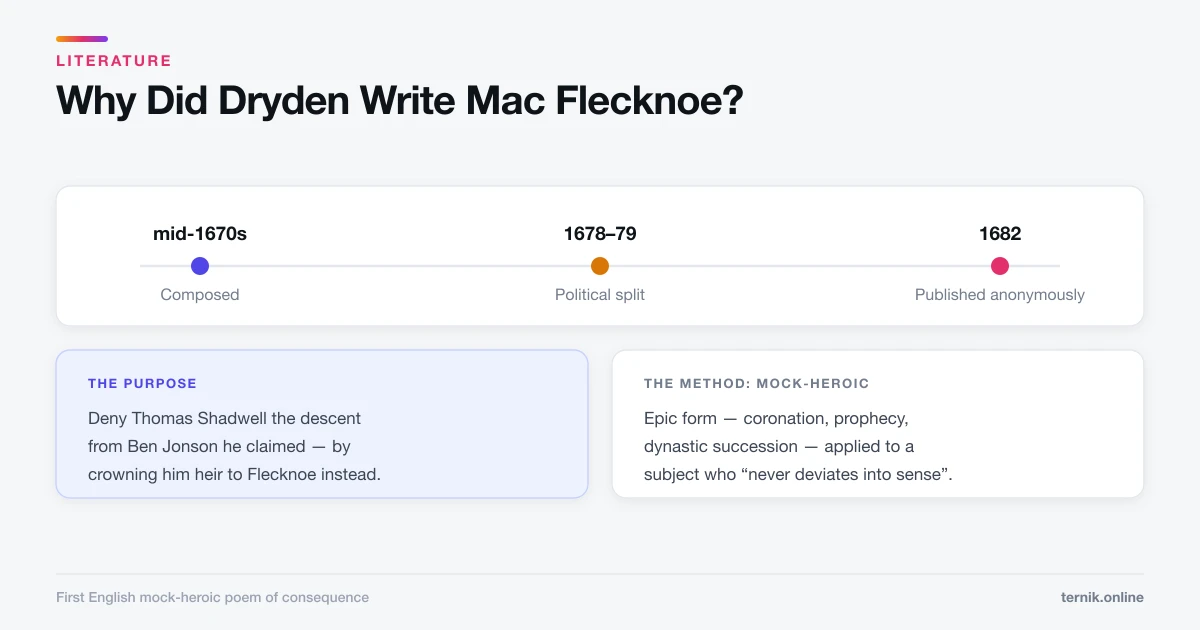
The essential move in both poems is the same, and it is explained in what is mock-heroic poetry: the satire is carried by the gap between the grandeur of the form and the smallness of the subject, not by anything the poet asserts.
What Pope changed
Three changes turn an inheritance into a new thing.
Scale of target. Dryden attacks one man — Thomas Shadwell, for reasons set out in why Dryden wrote Mac Flecknoe. Pope attacks an entire ecosystem: hack writers, publishers, critics, pedants, and the commercial machinery that fed them.
A presiding deity. Pope supplies a goddess of Dullness with intentions and a programme. Dryden's dullness is a quality; Pope's is an active force with agency.
An ending. The Dunciad closes with the extinguishing of light and the return of universal darkness — a claim about civilisation itself. Mac Flecknoe has no equivalent; it finishes when the coronation is complete.

The two poems side by side
| Mac Flecknoe | The Dunciad | |
|---|---|---|
| Published | 1682 (composed mid-1670s) | 1728; four books by 1743 |
| Target | One rival playwright | A literary culture |
| Length | A few hundred lines | Four books |
| Presiding figure | Flecknoe, an ageing poetaster | Dullness, a goddess |
| Scope of claim | This man is a dunce | Civilisation is going dark |
| Tone | Contained, precise | Expansive, apocalyptic |
Why Pope needed a bigger frame
Dryden's poem works because its target is one person with a specific claim to dismantle — Shadwell's assertion of descent from Ben Jonson. Deny the lineage and the job is done.
Pope's grievance had no single owner. His complaint was against a print culture he saw as rewarding volume over judgement: subscription publishing, hack biography, unqualified criticism. Mock-heroic could carry that, but only if inflated. Hence the goddess, the four books, and the apocalyptic close.
The expansion has a cost. Mac Flecknoe is sharper, and it keeps working even for readers who know nothing about the quarrel behind it. The Dunciad requires far more annotation, because it names people who mean nothing to a modern reader.
The uncomfortable inheritance
Both poems demonstrate the same thing: a sufficiently good poem can permanently fix how a person is remembered, regardless of what they did.
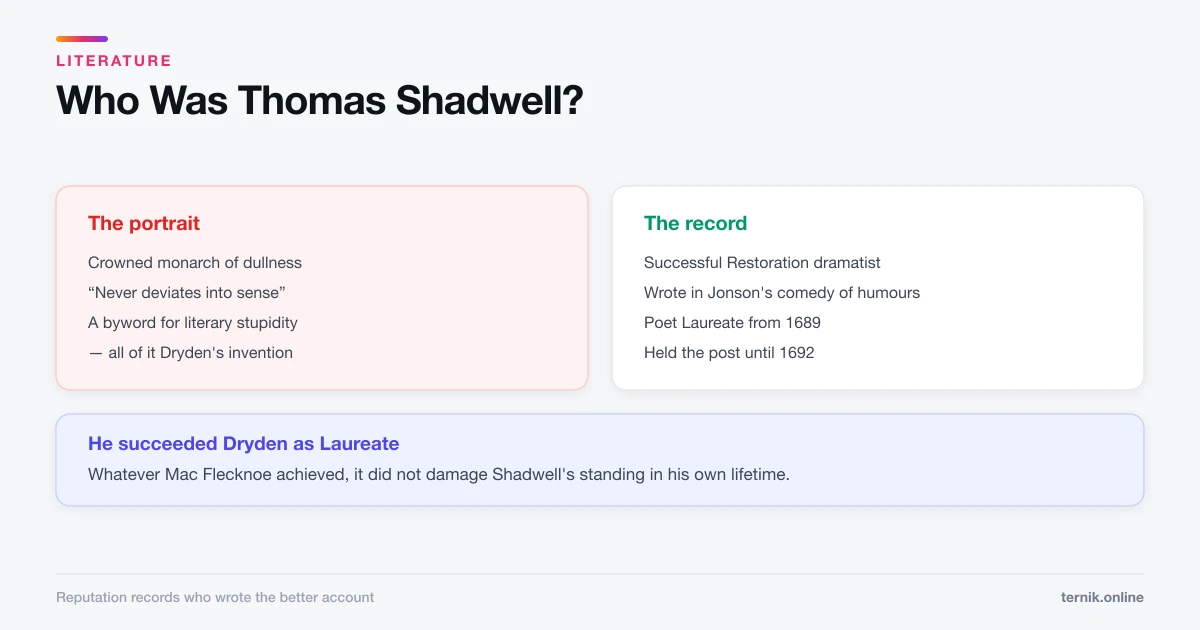
Shadwell was a successful dramatist who became Poet Laureate after Dryden lost the post — the record is in who was Thomas Shadwell — and he survives as a byword for stupidity. Many of Pope's dunces were working writers whose entire posthumous existence is a line in a poem attacking them.
Neither poet was making a scholarly case. Both were winning an argument by being better at writing than the people they were arguing with. That is worth holding onto when reading either as literary history: what you are reading is the winning side's account, preserved because it was better made.
Reading them together
Take Mac Flecknoe first — it is short, and its method is easier to see at small scale. Read the coronation, then look for the same structure in The Dunciad's opening book.
The most useful question to carry across is: what is the epic form being applied to here, and what would this passage look like stated plainly? The distance between those two is the whole technique, in both poems.
Frequently asked questions
Directly. Mac Flecknoe is generally described as the immediate ancestor of The Dunciad — Pope took Dryden's coronation-of-dullness structure and epic diction and expanded them.
Sources
Keep reading
More guides to grow your account.